
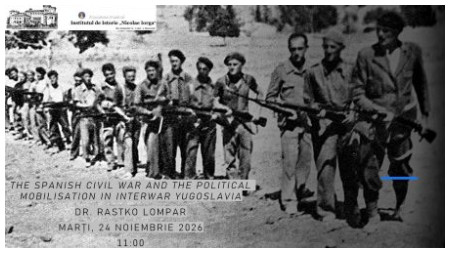
 The lecture will examine how the Spanish Civil War (1936–1939) shaped political mobilisation in interwar Yugoslavia, focusing on the responses of all major political actors, from the left to the right. It will explore how the conflict became a focal point of domestic political struggles, reshaping alliances, deepening existing divisions, and transforming political discourse. Above all, the Spanish Civil War represented a moment when previously irreconcilable opponents found common ground, while long-standing alliances began to fracture, revealing the shifting and often unexpected dynamics of Yugoslav political life.
Rastko Lompar is a research associate at the Institute for Balkan Studies of the Serbian Academy of Sciences and Arts. His research interests include fascism, transnational anticommunist networks, history of right-wing movements in Yugoslavia and the relationship between fascism and religion. His first book titled Dimitrije Ljotić: Teacher or Pharisee? (2021, in Serbian), analyses the relationship between fascism and religion within the Zbor movement in interwar Yugoslavia. His latest book is Holly Alliance: Anticommunism in interwar Yugoslavia (2026, in Serbian).