
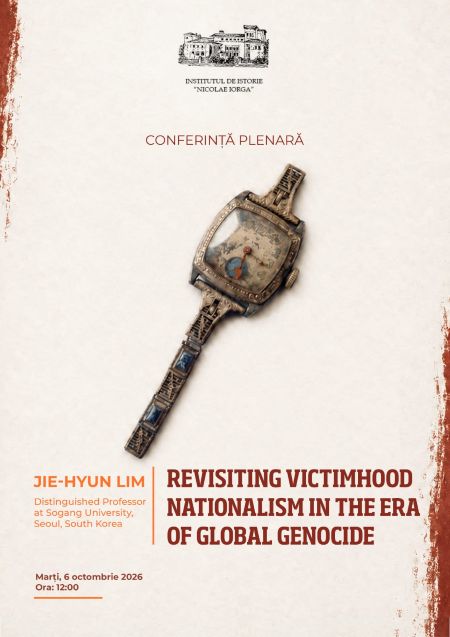
 Institutul de Istorie Nicolae Iorga (Academia Română) vă invită, marți, 6 octombrie, orele 12, la conferința plenară Revisiting Victimhood Nationalism in the Era of Global Genocide susținută de Jie-Hyun Lim (Distinguished Professor at Sogang University). Evenimentul va avea loc la sediul Institutului, Bulevardul Aviatorilor, nr.1.
Sumar
The postwar consensus held that Holocaust memory would function as a universal prophylaxis against atrocity; "never again" was enshrined as the ethical cornerstone of the global human-rights regime. Yet as Gaza is reduced to rubble and Ukrainian cities burn, we are compelled to confront an uncomfortable proposition: the memory of past suffering has not reliably forestalled contemporary genocide but has, in significant measure, furnished its justificatory grammar. This lecture revisits the concept of "victimhood nationalism" to interrogate why the twentieth century's most solemn mnemonic vow so persistently inverts into its opposite.
Victimhood nationalism operates as a narrative template that transmutes a legacy of ancestral suffering into moral legitimacy and a post-mortem alibi for the present. Its most consequential operation is grammatical: it silently rewrites the universal "never again" into the particularist "never again for us." Once victimhood becomes hereditary—inherited by a postmemory generation as inalienable property—the nation lays claim to a collective innocence that forecloses reflection on its own capacity for perpetration. The Israeli mobilization of Holocaust memory in Gaza, the counter-mobilization of colonial victimhood by Hamas, and Putin's narrative of Russian martyrdom at the hands of a "collective West" are not aberrations but victimhood nationalism functioning precisely as designed: the weaponization of an entangled past to authorize violence in the present.
Drawing on the transnational entanglements that bind Auschwitz to Hiroshima, Jedwabne to the "comfort women," this talk argues that the competitive quantification of suffering dehumanizes the very victims it purports to honor. The Holocaust's most sinister lesson, I contend, is not that such atrocity may befall us again, but that we—the innocent, the aggrieved, the righteous—remain fully capable of perpetrating it. The task of the present is therefore not to guard victimhood more jealously, but to relinquish it in favor of mnemonic solidarity.
Jie-Hyun Lim is a Distinguished Professor at Sogang University. He is the Series Editor of “Mass Dictatorship” at Palgrave/Macmillan, and “Global Easts” at the Central European University Press. His recent books include Victimhood Nationalism: History and Memory in a Global Age (Columbia Univ. Press, 2025), Opfernationalismus. Erinnerung und Herrschaft in der postkolonialen Welt (Klaus Wagenbach, 2024), Global Easts: Remembering, Imagining, Practicing (Columbia Univ. Press, 2022), and Mnemonic Solidarity-Global Interventions (Palgrave, 2021, co-edited with Eve Rosenhaft). As a memory activist, he has co-curated exhibitions of “Unwelcome Neighbors” focusing on the Roma and Sinti victims of the Holocaust and “Naming the Nameless” on the forced labor in the Japanese empire.