
Studies and Materials of Modern History
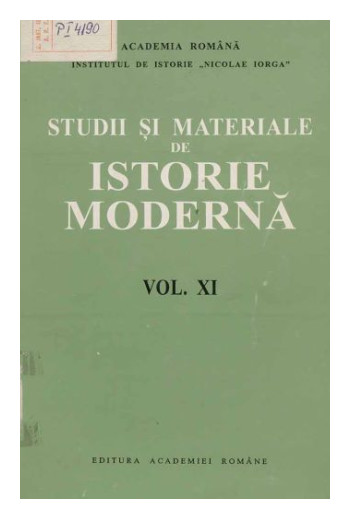
Studies and Materials of Modern History is a journal founded in 1957, dedicated to research in modern history from the late 18th century to the early 20th century. The journal publishes original interpretive articles, documentary contributions, reviews and book notes, as well as reports on academic events and debates.
A short history
Founded in 1957, Studies and Materials of Modern History is a journal primarily dedicated to the history of the Romanian people from the late 18th century to the early 20th century. From the very beginning, major historical events and developments—such as the 1848 Revolution, the Era of the Union, the War of Independence, and World War I—have occupied a prominent place in its content. At the same time, the magazine published articles on economic, social, and art history, such as those concerning the transformations in industry and agriculture in the 19th century, the agrarian crises, the 1875 trade agreement between Romania and Austria-Hungary, trade with Germany, navigation on the Danube, the book trade, tenant farming, the consequences of the 1864 Rural Law, the situation of children, and Romanian art education. At the same time, articles were published on the relations of the Romanian Principalities and Romania with other states and the image of Romanians abroad, for example, Romanian-Italian relations or the Eastern Question.
Another important aspect of the journal’s work has been the publication of documents, drawing on both internal and external sources. In this regard, we note the accounts of several foreign travelers. In recent decades, the journal’s scope of interest has expanded to include analytical or methodologically focused articles on topics such as the use of historical databases or the internet as a research tool. It has also begun to address theoretical issues falling under the history of political ideas and cultural history: see, for example, the articles on liberalism, Marxism, and popular culture. In recent years, the journal has introduced a section titled “Under Debate,” in which various experts discuss current issues, such as the relationship between politics and culture or the implications of online education.
Over the years, the Editorial Board has been led by prominent figures in the field of historiography, including: Gheorghe Haupt and Gheorghe Georgescu-Buzău (1957–1960), Nichita Adăniloaie and Dan Berindei (1960), Andrei Oţetea (1963–1972); Nichita Adăniloaie and Dan Berindei (1973–1983); Apostol Stan (1994–1999), Acad. Dan Berindei (2001–2021); and Dorina Rusu, corresponding member of the Romanian Academy (since 2022). The Scientific Board and Editorial Committee of the journal included several specialists from within and outside the Institute, among whom we mention Keith Hitchins (University of Urbana-Champaign, Illinois), Francesco Guida (Roma Tre University), Jean-Paul Bled (Sorbonne University, Paris VI), Vladislav Iakimovici Grosul (Institute of Russian History, Moscow), Paul Cernovodeanu, Georgeta Penelea-Filitti, Daniela Buşă, Adrian Silvan-Ionescu, Dumitru Vitcu (the “A.D. Xenopol” Institute of History of the Romanian Academy), and Andrei Eşanu (honorary member of the Romanian Academy, Institute of History of the Academy of Sciences of the Republic of Moldova). In addition to researchers from the “Nicolae Iorga” Institute of History, the journal’s contributors included professors and researchers from other centers, both in Romania and abroad, such as Gheorghe Platon, Andrei Pippidi, Nicolae Isar, Vitalie Văratec, Constantin Ardeleanu, Cristian Ploscaru, Ecaterina Lung, Lidia E. Semeonova, Trevor J. Hope, and Claude Karnoouh.
Online access. Journal Studies and Materials of Modern History it is printed, but its content is also available in digital form here.

Editorial Board
Editorial Board: Jean-Paul Bled (Sorbonne University, Paris VI), Francesco Guida (Roma III University), Andrei Eșanu, honorary member of the Romanian Academy (Institutul de Istorie al Academiei de Ştiinţe a Republicii Moldova), Dumitru Vitcu (Institutul de istorie „A. D. Xenopol”, Iaşi).
Editorial Team: Dorina Rusu, corresponding member of the Romanian Academy (editor-in-chief), Alexandru Mamina (deputy editor-in-chief), Bogdan Mateescu (editorial secretary), Raluca Tomi, Daniel Gicu.
Writing Guidelines
Manuscripts should be submitted in .doc, .docx, or .rtf format, using 12-point Times New Roman font, 10-point footnotes, and single-line spacing. Articles must be accompanied by an abstract (preferably in English or French) and 3–5 keywords..
Bibliographic references
Books, monographs by individual authors: First Name, Last Name, Title. Subtitle, City, Publisher, Year, p.
First citation: Nicolae Iorga, Pagini de tinereţe, Bucureşti, Editura pentru Literatură, 1968, p. 17.
Following citations: Nicolae Iorga, Pagini de tinereţe, şi urm., p...
If there are multiple authors, their names are separated by a semicolon (;).
Contributions to edited volumes: First Name, Last Name, Title. Subtitle, in First Name, Last Name, Title. Subtitle, City, Publisher, Year, p.
Example: Daniela Buşă, Bucureşti, oraş al contrastelor. O capitală europeană la mijlocul secolului al XIX-lea, în Irina Gavrilă (coord.), Frontierele necunoscutului. De la vest la est prin ţările române. Impresii de călătorie (secolul XIX), Bucureşti, Editura Oscar Print, 2011, p. 63.
Articles in magazines and newspapers: First Name, Last Name, Title, in „The name of the Magazine”, Year, no., p.
Example: Constantin Ardeleanu, Implicarea României în conflictele balcanice reflectată în corespondenţa diplomatică britanică (1912-1913), în „Studii şi Materiale de Istorie Modernă”, vol. XXVII, 2014, p. 39.
Archival Materials: Archive name, Fund, Years, File, p.
Exemplu: Arhivele Naţionale Istorice Centrale (ANIC), Fond General Alexandru Socec 1877-1951, dosar 4/1880-1883, f. 63v.
In the case of references to electronic sources the full address and the date of the last visit must be provided. http://.... (last visit: 14.11.2017).
Numerals
They will be written in accordance with the guidelines of the Romanian Academy Publishing House: 1 000; 10 000; 1 000 000.
Names of historical events
The names of historical events should be written in lowercase letters: world war I, the 1848 revolution, the second balkan war.
Articles that do not comply with these guidelines will be returned to the authors.
Ethical standards
The editorial process
The editorial board enjoys complete editorial independence and strives to prevent any compromise that might arise from conflicts of interest or financial and political interference. The journal does not discriminate against authors, editors, or reviewers on the basis of religion, race, or gender.
Publishers obligations
Non-discrimination and equal opportunity. The editors’ decision to accept a manuscript for publication or, conversely, to reject it will be based solely on the scientific merit, originality, and clarity of the submission, as well as its relevance to the journal’s general scope. Articles submitted for publication are evaluated solely on the basis of their content, without any discrimination based on the authors’ religious or political beliefs, ethnic origins, race, or gender.
Authors obligations
Studies and Materials of Modern History accepts only original scientific papers; authors are required to take responsibility for the text submitted for publication and to ensure that they accurately cite the works they have used.
Evaluators obligations
The content of the manuscripts received and the review process are confidential. Any person who finds themselves in a conflict of interest that could influence the objectivity of the review is required to notify the Editorial Board.
Anti-plagiarism policy
The journal does not tolerate plagiarism and reserves the right to check any manuscript submitted for publication. Articles or reviews suspected of plagiarism will be rejected.
Article evaluation
All submissions should be sent to the journal's email address, smimodcontact@gmail.com, which will then undergo a peer-review process. The editorial board will notify the author whether the submitted material has been rejected or accepted for publication.
Manuscripts submitted for publication will be reviewed by referees selected by the journal’s editorial board; the process is anonymous at every stage.
Archive
The journal Studies and Materials of Modern History it is printed, but its content is also available in digital form here.
Last number is available for reading here.
Contact
Institutul de Istorie „Nicolae Iorga” al Academiei Române, Bd. Aviatorilor nr. 1, sect. 1, Bucureşti, cod 011851; tel: 0212125337: fax: 0213110371
Email: smimodcontact@gmail.com